
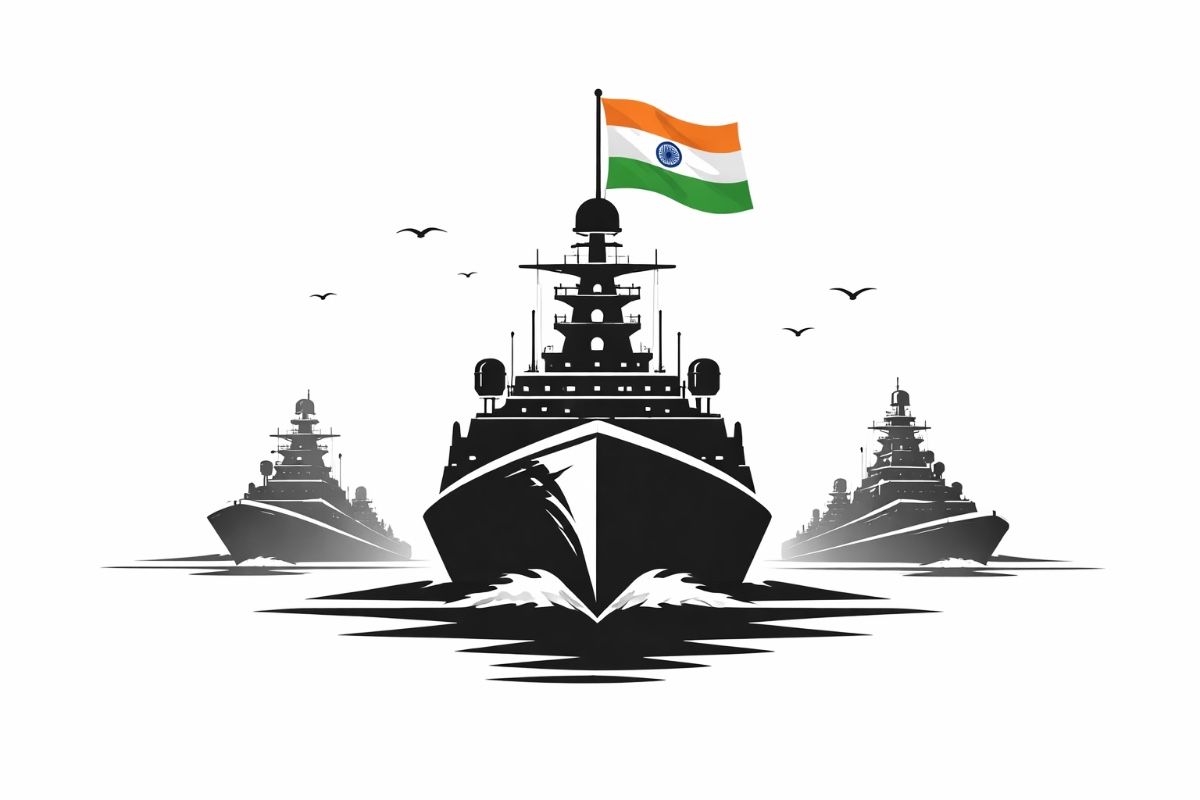
India is set to host the International Fleet Review (IFR) 2026, a major global naval event that will bring together warships and naval leaders from friendly countries. The announcement signals India’s growing maritime role and its continued focus on strengthening naval diplomacy in the Indo-Pacific region.
The International Fleet Review is not just a ceremonial display of ships. It is a powerful symbol of maritime strength, cooperation, and strategic partnerships. With India increasing its focus on naval modernisation and regional security, hosting IFR 2026 carries strong diplomatic and defence significance.
This event comes as India expands its maritime capabilities and deepens ties with partner navies across Asia, Europe, Africa, and beyond.
What Is the International Fleet Review (IFR)?
An International Fleet Review is a large naval gathering where warships from multiple countries assemble at a designated port. The event typically includes:
- A ceremonial fleet review by the Head of State
- Participation of foreign naval ships
- Maritime exercises and operational interactions
- Cultural and diplomatic engagements
Fleet reviews are held by maritime nations to showcase naval strength and promote cooperation.
India previously hosted the International Fleet Review in 2001 (Mumbai) and 2016 (Visakhapatnam). The 2016 edition saw participation from over 50 countries, making it one of the largest naval gatherings in the region.
Where Will IFR 2026 Be Held?
While official details regarding the exact venue are awaited, India has historically hosted major fleet reviews in coastal cities with strong naval presence, including:
- Visakhapatnam
- Mumbai
Visakhapatnam hosted the 2016 International Fleet Review and remains one of the Indian Navy’s key operational hubs under the Eastern Naval Command.
An official confirmation regarding the host city for 2026 is expected closer to the event date.
Who Organises the International Fleet Review in India?
The event is organised by the Indian Navy under the guidance of the Ministry of Defence.
Traditionally, the President of India, who serves as the Supreme Commander of the Armed Forces, reviews the fleet during the ceremonial parade.
The review involves naval ships lined up in formation at sea, with the President inspecting the fleet from a designated vessel.
Why IFR 2026 Matters for India
1. Strengthening Naval Diplomacy
The International Fleet Review is a platform for maritime diplomacy. It allows India to:
- Engage directly with foreign naval chiefs
- Conduct bilateral and multilateral interactions
- Deepen defence partnerships
Naval cooperation has become central to India’s foreign policy, especially in the Indo-Pacific region.
2. Showcasing Maritime Capability
India has significantly modernised its navy over the past decade. Major additions include:
- Indigenous aircraft carriers
- Advanced destroyers and frigates
- Submarines under Project 75
- Maritime patrol aircraft
Hosting IFR 2026 provides an opportunity to present these capabilities to global partners in a formal setting.
3. Supporting Indo-Pacific Security
The Indo-Pacific region has emerged as a key strategic focus. Sea lanes in this region carry a large share of global trade.
India has consistently supported a free, open, and rules-based maritime order. Events like IFR reinforce India’s role as a responsible maritime power.
4. Boost to Coastal Infrastructure
Hosting an international naval event requires:
- Port upgrades
- Security arrangements
- Logistics coordination
- Hospitality and event management
Such events often strengthen local infrastructure and maritime readiness.
A Look Back: International Fleet Review 2016
India last hosted the International Fleet Review in February 2016 at Visakhapatnam.
Key highlights from the 2016 edition:
- Participation from over 50 countries
- Around 100 ships, including foreign naval vessels
- Large-scale operational demonstrations
- Cultural programmes and band performances
The event was reviewed by the then President of India and drew global attention.
IFR 2026 is expected to build on that experience.
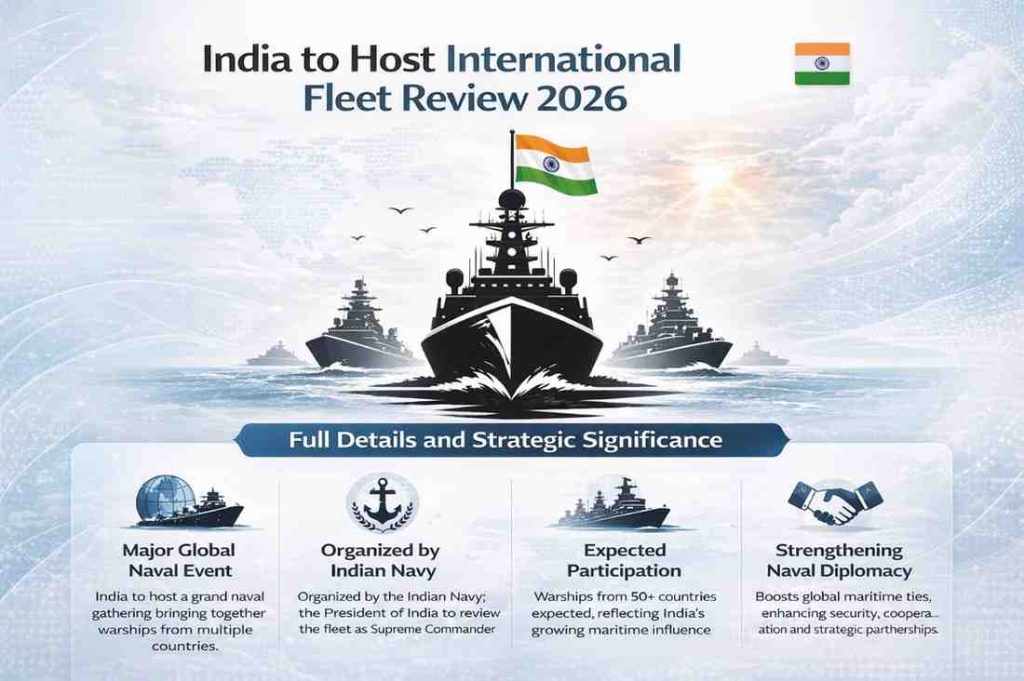
How International Fleet Reviews Work
Fleet Formation at Sea
Warships from participating countries anchor in a designated maritime zone. The host nation arranges ships in an organised formation.
Presidential Review
The President of India sails past the formation and formally reviews the fleet. This is a ceremonial tradition followed by many maritime nations.
Naval Engagements
Beyond ceremony, IFR includes:
- Professional exchanges
- Joint maritime discussions
- Operational coordination talks
These engagements help improve communication between navies.
India’s Growing Naval Role
The Indian Navy has expanded its operational reach in recent years. It conducts:
- Anti-piracy patrols
- Humanitarian assistance missions
- Maritime surveillance
- Joint exercises with friendly countries
India also participates in major multilateral naval exercises and regional forums.
Hosting IFR 2026 aligns with this growing engagement.
Strategic Context: Why 2026 Is Important
The maritime domain is becoming more competitive globally. Security challenges include:
- Sea lane security
- Maritime disputes
- Disaster response
- Climate-related coastal risks
By hosting an International Fleet Review, India reinforces its commitment to cooperation and stability.
It also strengthens confidence among regional partners.
Public Engagement and National Pride
International Fleet Reviews are not limited to defence officials.
Past editions included:
- Ship visits for civilians
- Naval exhibitions
- Cultural exchanges
- Youth outreach programmes
Such activities build awareness about the Navy’s role in national security.
For coastal cities, IFR becomes a moment of national visibility and pride.
Economic and Tourism Impact
Large-scale naval gatherings attract:
- Delegations
- International media
- Defence observers
- Tourists
Local hospitality, transport, and event services often benefit during such events.
While defence remains the core purpose, the economic ripple effect can be significant for the host city.
India’s Maritime Vision
India has consistently promoted initiatives such as:
- SAGAR (Security and Growth for All in the Region)
- Strengthening coastal security
- Blue economy development
IFR 2026 fits into this larger maritime vision.
It reinforces India’s image as a stable and cooperative naval power.
What to Expect Next
Detailed schedules, participating nations, and venue confirmation are likely to be announced by the Ministry of Defence and the Indian Navy closer to the event.
Typically, preparations begin well in advance, given the scale of coordination required.
Security arrangements are also extensive during such international events.
Key Takeaways for Readers
- India will host International Fleet Review 2026
- Organised by the Indian Navy
- Brings together naval ships from multiple countries
- Symbolises maritime strength and cooperation
- Enhances India’s global naval profile
Conclusion
The International Fleet Review 2026 is more than a naval parade. It is a statement of India’s maritime ambitions and diplomatic outreach.
As global focus shifts increasingly toward the seas, India’s decision to host IFR 2026 highlights its growing role in shaping regional maritime stability.
For Indian readers, the event represents national capability, strategic confidence, and international engagement all converging on the country’s coastline in 2026.
Disclaimer: The information presented in this article is intended for general informational purposes only. While every effort is made to ensure accuracy, completeness, and timeliness, data such as prices, market figures, government notifications, weather updates, holiday announcements, and public advisories are subject to change and may vary based on location and official revisions. Readers are strongly encouraged to verify details from relevant official sources before making financial, investment, career, travel, or personal decisions. This publication does not provide financial, investment, legal, or professional advice and shall not be held liable for any losses, damages, or actions taken in reliance on the information provided.
Last Updated on: Wednesday, February 18, 2026 2:17 pm by Outlook News Team | Published by: Outlook News Team on Wednesday, February 18, 2026 2:17 pm | News Categories: India
About The Author