


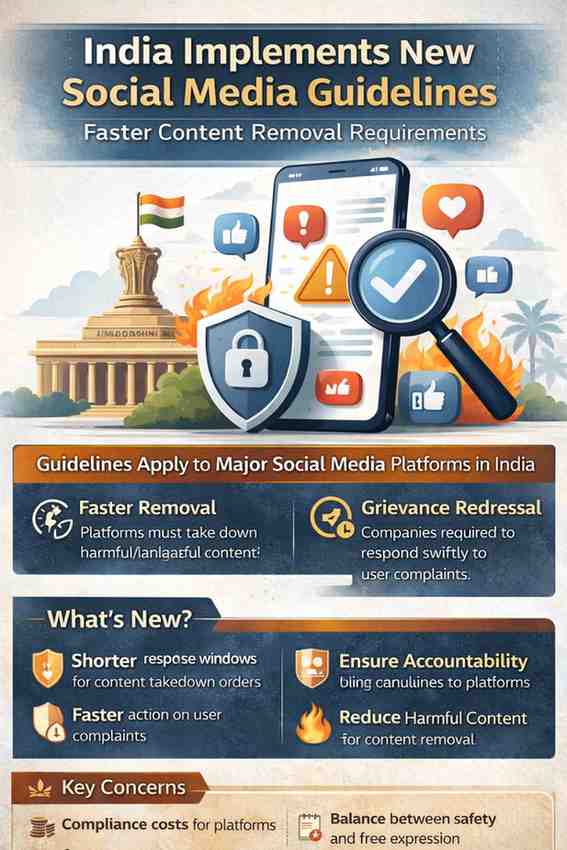
The Government of India has introduced new social media guidelines that require faster removal of certain types of online content. The move is aimed at strengthening digital safety, improving accountability of platforms, and addressing harmful or unlawful material more quickly.
The updated framework places stricter timelines on social media companies operating in India. Platforms will now be expected to respond more rapidly to government orders and user complaints related to illegal or harmful content.
The development is significant because India is one of the world’s largest digital markets, with hundreds of millions of active internet users. Any change in regulation directly affects users, tech companies, and digital businesses.
Here is a detailed look at what the new rules mean and how they may impact social media users and platforms.
What Are the New Social Media Guidelines?
The new guidelines build on existing digital regulations and focus on faster content removal requirements.
Under the updated rules:
- Platforms must act within tighter timelines after receiving valid legal orders
- Certain categories of content must be reviewed and removed more quickly
- Companies are expected to strengthen grievance redressal systems
The goal is to ensure that unlawful, harmful, or misleading content does not remain online for extended periods.
The guidelines apply to major social media intermediaries operating in India.
Why the Government Updated the Rules
India has seen rapid growth in digital usage. Social media platforms play a major role in information sharing, political communication, entertainment, and business promotion.
However, concerns have also increased regarding:
- Fake news
- Hate speech
- Online harassment
- Misinformation
- National security risks
The government has stated that faster response mechanisms are necessary to maintain public order and digital safety.
Officials argue that stronger enforcement will improve accountability among tech companies.
Faster Content Removal: What Changes Now?
One of the most important changes is the reduced response time for content removal.
Earlier, platforms were required to respond within specified legal timelines. The updated framework reduces these windows in certain cases.
Key highlights include:
- Swift action after receiving government directives
- Prompt review of user complaints
- Mandatory reporting of compliance
The aim is to ensure that harmful content does not spread widely before action is taken.
Grievance Redressal System Strengthened
Social media companies will need to maintain:
- A grievance officer in India
- A system for tracking complaints
- Timely resolution of user reports
Users will be able to file complaints if they believe content violates Indian law.
Companies must acknowledge complaints quickly and act within defined time limits.
This step is designed to give users more power in reporting problematic content.
Impact on Major Social Media Platforms
The new rules affect all major social media intermediaries operating in India, including global tech firms.
These companies may need to:
- Increase moderation teams
- Use stronger automated tools
- Improve compliance reporting
- Strengthen coordination with Indian authorities
Failure to comply could lead to penalties under Indian law.
For platforms, this means higher compliance responsibility in one of their largest markets.
Balancing Regulation and Free Expression
While the government says the new guidelines aim to improve safety, digital rights experts often stress the importance of protecting free speech.
Any regulation of online content must balance:
- Public safety
- Legal compliance
- Freedom of expression
Clear definitions and transparent processes will be important in ensuring fairness.
How This Affects Social Media Users in India
For ordinary users, the changes may result in:
- Faster removal of harmful posts
- Better response to harassment complaints
- Improved grievance tracking
However, users may also see stricter enforcement of platform rules.
Content that violates Indian laws may be removed more quickly than before.
Legal Framework Behind the Guidelines
India regulates online platforms under the Information Technology laws and related rules.
The updated guidelines operate within this broader legal framework.
The government has repeatedly said that intermediaries must act responsibly when notified about unlawful content.
Non-compliance can impact safe harbour protections for companies.
India’s Growing Digital Market
India has one of the largest social media user bases in the world.
Millions of Indians use platforms daily for:
- News
- Business
- Education
- Entertainment
- Political discussions
With such scale, even small regulatory changes can have wide impact.
As internet penetration continues to grow, digital governance has become a key policy area.
Global Trend Toward Stricter Digital Regulation
India is not alone in tightening digital rules.
Several countries are introducing stronger content moderation laws.
Governments worldwide are focusing on:
- Data protection
- Online safety
- Platform accountability
India’s move aligns with this broader global trend.
Concerns Raised by Industry Observers
Some technology experts have highlighted potential challenges:
- Increased compliance costs
- Risk of over-removal of content
- Operational burden on smaller platforms
Clear implementation guidelines will be important to avoid confusion.
Transparency in enforcement will also play a key role.
What Happens Next?
With the new guidelines in place, social media platforms will need to update internal policies.
Possible next steps include:
- Revised moderation protocols
- Stronger content monitoring tools
- Public compliance reports
The effectiveness of the new rules will depend on enforcement and cooperation between authorities and tech companies.
Key Takeaways
Here are the major points from the updated social media guidelines:
- Faster removal timelines for certain types of content
- Stronger grievance redressal system for users
- Higher compliance responsibility for platforms
- Potential penalties for non-compliance
The rules aim to improve online safety while ensuring platforms remain accountable.
Conclusion: A Major Shift in Digital Regulation
The introduction of new social media guidelines in India marks a significant step in digital governance.
With faster content removal requirements, the government aims to reduce the spread of harmful or unlawful material online.
For users, this may mean quicker action on complaints. For platforms, it means stricter compliance standards.
As implementation begins, all stakeholders will watch closely to see how the rules shape India’s digital ecosystem.
The coming months will reveal how effectively the new framework balances safety, accountability, and free expression in one of the world’s largest internet markets.
Disclaimer: The information presented in this article is intended for general informational purposes only. While every effort is made to ensure accuracy, completeness, and timeliness, data such as prices, market figures, government notifications, weather updates, holiday announcements, and public advisories are subject to change and may vary based on location and official revisions. Readers are strongly encouraged to verify details from relevant official sources before making financial, investment, career, travel, or personal decisions. This publication does not provide financial, investment, legal, or professional advice and shall not be held liable for any losses, damages, or actions taken in reliance on the information provided.
Last Updated on: Wednesday, February 11, 2026 3:15 pm by Outlook News Team | Published by: Outlook News Team on Wednesday, February 11, 2026 3:15 pm | News Categories: Tech
About The Author