
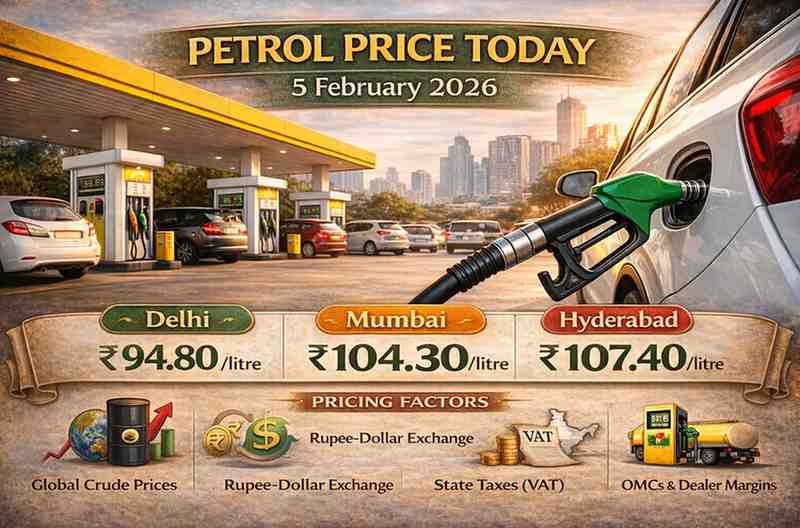
Petrol prices in India on Thursday, 5 February 2026, remained largely stable in most major cities as oil marketing companies maintained rates under the daily dynamic pricing regime. In Delhi, petrol continued to retail below ₹95 per litre. In Mumbai, prices were above ₹104 per litre. In Hyderabad, the pump price edged above ₹107 per litre. Consumers in different states face differing rates because of state-level value-added tax (VAT) and dealer commission structures added to the basic rate set by oil companies. All retail prices are determined daily and take effect at 6 a.m. local time.
Background: how petrol prices are set in India
Since the deregulation of fuel pricing in June 2010, retail petrol and diesel prices in India have been governed by a dynamic pricing system. Under this system, the three major government-owned oil marketing companies Indian Oil Corporation, Bharat Petroleum and Hindustan Petroleum revise fuel rates every day based on changes in international crude oil prices, the value of the Indian rupee against the US dollar, freight and dealer costs, and state and central taxes. The price at the pump therefore reflects global market conditions and local tax structures.
Central excise duty is uniform nationwide, but the final retail price differs from city to city because of variations in value-added tax (VAT) levied by state governments. These VAT differences often make up a substantial portion of the petrol price variation between states. Petrol prices are published on official oil marketing company websites and updated daily before 6 a.m. GST on VAT and excise duty does not directly make petrol cheaper because petrol fuel remains outside the GST regime; excise and VAT are levied as separate charges.
Petrol prices on 5 February 2026: city-wise snapshot
Verified data collected from national and regional fuel price trackers show that petrol prices on 5 February 2026 stood as follows in major Indian cities:
In the national capital city of Delhi, retail petrol was priced at approximately ₹94.7–₹94.8 per litre. Price trackers mirror figures that showed no significant change from the previous day, reflecting stable conditions in both global crude and local tax components.
In Mumbai, petrol retail prices were around ₹104.2–₹104.3 per litre on the same date, placing them among the higher city rates in India. The margin between Mumbai and Delhi is primarily due to differences in the Maharashtra state VAT on petrol.
In Hyderabad, petrol was being sold at roughly ₹107.4–₹107.5 per litre, among the highest quoted pin codes in major metros that day. Local taxes and dealer markups contribute to this elevated figure compared with northern and western metro markets.
For context, petrol prices in other cities reported on the same date ranged from around ₹99.8 per litre in Bangalore to about ₹103.9 per litre in Kolkata, highlighting regional variation across India.
Daily retail petrol prices are available on fuel price tracking platforms and official oil company portals; consumers can search by city to see precise figures as of the 6 a.m. update on any given day.
Developments affecting petrol pricing
Retail petrol prices are sensitive to several factors, most importantly international crude oil markets and the rupee-dollar exchange rate. Crude oil benchmarks such as Brent and WTI have fluctuated in recent months owing to shifting global demand, geopolitical tensions in key producing regions and production decisions by major oil-exporting nations.
In early 2026, crude oil prices remained within a broad range established over the latter part of 2025, contributing to the observed stability in India’s retail fuel prices. OMCs typically pass through changes in global crude prices to consumers via the dynamic pricing mechanism, often with little lag. Likewise, changes in the value of the Indian rupee against the US dollar in which crude oil is traded globally directly affect the underlying cost base for petroleum product pricing.
State fiscal policies also influence retail petrol pricing. Value-added tax (VAT) on petrol differs by state. Some states levy higher VAT rates on petroleum products, contributing to higher final pump prices. Likewise, dealer commissions and transport costs vary regionally, adding to inter-city differences. As of early 2026, Hyderabad and other parts of Telangana exhibited higher retail prices in part because of the state’s tax structure relative to civic rates in Delhi and Gujarat.
Finally, while central excise duty levels are uniform across India, periodic government adjustments to excise duty influence baseline pump prices. Budgetary or interim fiscal decisions can increase or decrease the central excise component, though no major duty change was notified immediately before 5 February 2026.
Impact on consumers and the economy
Petrol prices have a direct bearing on household budgets and transportation costs. For individuals who rely on private vehicles for commuting, small changes in per-litre fuel cost can have material effects on monthly expenditure, particularly in urban centres with heavy daily travel.
Higher petrol prices influence the broader cost of goods and services because they increase transportation costs across supply chains. This can feed into inflationary pressures in the economy. Even when petrol rates remain stable, consumers and analysts monitor price movements regularly because of the tight linkages between fuel costs, inflation, and discretionary spending.
Regional price disparities also impact consumer decisions, such as cross-border fuel purchases near state boundaries where price differences are notable. A commuter residing near two state jurisdictions may encounter different retail prices over short distances, affecting economic behaviour in border districts.
Commercial sectors such as logistics, delivery services, and freight transport are particularly sensitive to petrol costs. Fluctuations in fuel prices can affect operating margins and, by extension, pricing of goods in various sectors.
Why petrol prices differ between Indian cities
The retail price of petrol in India comprises multiple components:
The base price related to global crude oil benchmarks and refinery costs.
Central excise duty imposed by the Government of India at a uniform rate.
State value-added tax (VAT) or sales tax, which varies significantly from state to state.
Transport costs, dealer commissions and handling charges.
Because VAT rates are set by individual states, two cities in different states can have markedly different petrol prices even if the underlying crude and excise components are identical. For example, Delhi’s VAT on petrol is generally lower than that in Maharashtra or Telangana, contributing to lower retail prices in the national capital relative to Mumbai or Hyderabad.
How markets and government policy interact to shape petrol costs
International crude prices influenced by global demand forecasts, OPEC production decisions, geopolitical tensions in oil-producing regions, and macroeconomic indicators are transmitted to the Indian market through imports, refining margins and exchange rate effects. India imports the bulk of its crude oil needs, making it sensitive to such global dynamics.
When crude prices rise sharply, oil marketing companies often raise retail petrol prices to preserve commercial margins or reflect higher underlying costs. Conversely, a sustained fall in crude benchmarks can lead to lower pump prices if state taxes and logistical costs do not offset the reduction.
Policy interventions such as changes in central excise duty, temporary relief measures in the context of inflationary pressures, or state tax adjustments can also shape retail petrol prices. For example, previous fiscal actions by state governments to reduce value-added tax temporarily have been reported to lower competitive city petrol prices. Those measures, while not immediate in early 2026, illustrate the policy levers available to authorities.
Consumer response and expectations
Consumers typically track petrol price movements daily, particularly in urban centres where commuting costs comprise a significant portion of household expenditure. Petrol price notifications at 6 a.m. invariably influence daily planning, commute decisions, and private transport usage.
Stable petrol prices for extended periods as seen around early 2026 in some cities can ease inflation concerns and support consumer confidence. Conversely, volatility in the price of crude oil or abrupt policy changes could lead to rapid retail price adjustments, which consumers monitor closely.
Transparency and daily pricing
The dynamic pricing system introduced in 2017 was intended to increase transparency in fuel pricing by linking daily retail rates more directly with international crude oil prices and currency movements. Retail fuel prices are published online by oil marketing companies and fuel price aggregators, allowing consumers to check city-wise rates before refuelling.
Official fuel price portals and private aggregators draw data from OMC publications and local dealer price lists. Prices are updated at 6 a.m. India Standard Time, and commuters often check them via mobile apps, news websites and SMS services offered by the companies.
Looking ahead: factors that may influence future prices
Petrol prices are expected to continue evolving with global crude oil market developments, currency trends and domestic fiscal policies.
Crude oil markets may react to macroeconomic growth forecasts, demand from large consuming economies, geopolitical tensions in key producing regions, or production decisions by major oil exporters. A sustained upward pressure on crude benchmarks could, absent offsetting policy measures, lead to upward revisions in retail petrol prices. Likewise, a strengthening of the Indian rupee against the US dollar could moderate imported crude costs and rebalance retail pricing.
On the domestic front, any changes in central or state taxation whether through annual budgets or interim adjustments would influence final pump prices. State governments periodically review VAT on petroleum products, which could raise or lower retail prices depending on fiscal priorities.
Conclusion
Petrol prices in India on 5 February 2026 reflected the dynamic interplay of global crude benchmarks, currency movements, state tax structures and daily pricing policies implemented by oil marketing companies. Delhi recorded one of the lowest petrol rates among major metros, while Mumbai and Hyderabad exhibited higher retail prices due to local tax differences. Stable prices on that date provided short-term predictability for consumers, but the broader pricing environment remains sensitive to global and domestic economic developments.
Motorists, commercial transport operators and policymakers alike continue to monitor petrol rates closely, given their significance for daily life and economic activity. In India’s dynamic pricing regime, informed awareness of these daily rates and the forces shaping them helps households and businesses plan in an environment of fluctuating global commodities and regionally varied tax policies.
Last Updated on: Thursday, February 5, 2026 12:08 pm by Outlook News Team | Published by: Outlook News Team on Thursday, February 5, 2026 12:07 pm | News Categories: India
About The Author