


The New Income Tax Act, 2026 marks one of the most consequential overhauls of India’s personal taxation framework in decades. Replacing layers of amendments that had accumulated over time, the new law seeks to simplify compliance, reduce ambiguity for taxpayers, and align tax deductions more closely with real-time income flows. For salaried employees, the most visible impact of this transition will appear not in legal documents but on the monthly salary slip starting April 1, when pay structures, deductions, and disclosures begin to look noticeably different.
At its core, the Act attempts to make income taxation easier to understand for ordinary taxpayers while giving employers clearer rules on how tax should be calculated and deducted at source. The familiar components of gross pay, exemptions, deductions, and take-home salary remain, but the way these elements interact has been reshaped to reflect the government’s push toward transparency and predictability.
A Clearer Definition of Taxable Salary
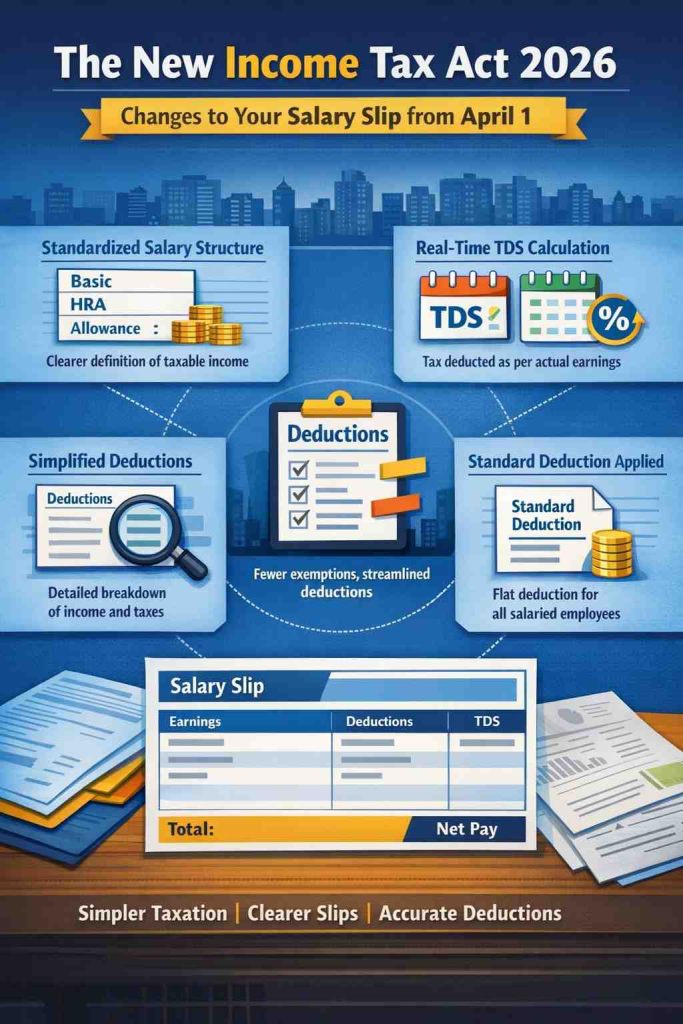
One of the key changes under the new law is a tighter and more explicit definition of what constitutes taxable salary income. Over the years, multiple allowances and reimbursements had created confusion for both employees and payroll departments. The New Income Tax Act consolidates these definitions, reducing the scope for varied interpretations across companies.
From April 1, salary slips are expected to show a more standardized breakup, with fewer grey areas around what is fully taxable, partially exempt, or no longer eligible for special treatment. This does not necessarily mean higher taxes for everyone, but it does mean that the structure of compensation packages is likely to be more uniform across sectors.
Alignment of Tax Deducted at Source with Actual Earnings
Another significant shift lies in how Tax Deducted at Source is calculated. Under the new framework, TDS on salaries is designed to mirror actual monthly earnings more closely rather than relying heavily on projections made at the start of the financial year. This change aims to reduce large tax adjustments at the end of the year, which often resulted in unexpected refunds or last-minute tax payments.
For employees, this means the tax deducted each month may fluctuate slightly if there are changes in bonuses, incentives, or variable pay. The upside is a salary slip that reflects a more accurate tax position throughout the year, reducing surprises when filing returns.
Fewer Deductions, Greater Simplicity
The New Income Tax Act 2026 continues the broader policy direction of moving away from a maze of deductions toward a simpler system with lower rates and fewer exemptions. While some commonly used deductions have been retained in a more streamlined form, others have been merged or rationalized to reduce paperwork and disputes.
On the salary slip, this translates into a shorter list of deduction lines and clearer visibility into how taxable income is computed. Employees who relied heavily on multiple small exemptions may notice a change in their net pay structure, while those who preferred simplicity over tax planning may find the new format easier to navigate.
Standard Deduction and Its Impact on Take-Home Pay
The concept of a standard deduction has been retained and recalibrated under the new law to offer relief to salaried taxpayers without requiring additional documentation. Instead of claiming several work-related exemptions, employees benefit from a flat deduction that is automatically factored into payroll calculations.
This change simplifies salary processing and reduces the compliance burden on both employers and employees. On the salary slip, the standard deduction appears as a single adjustment, making it easier to understand how gross salary translates into taxable income.
Greater Transparency in Salary Slips
One of the less discussed but important outcomes of the New Income Tax Act is the emphasis on transparency. Employers are encouraged to issue salary slips that clearly disclose taxable components, deductions applied, and tax deducted for the month. This move is intended to empower employees to understand their tax position without relying entirely on external consultants or year-end statements.
From April 1, many employees may notice redesigned salary slips that are more detailed yet easier to read, reflecting the Act’s focus on clarity and taxpayer awareness.
What This Means for Employees Going Forward
For salaried individuals, the New Income Tax Act 2026 is less about dramatic overnight changes and more about a gradual shift toward a cleaner, more predictable tax experience. While some may need to adjust expectations around exemptions and monthly deductions, the overall objective is to reduce complexity and make income taxation less stressful.
As the new rules take effect, employees are advised to review their first salary slip of the financial year carefully. Understanding the new structure early can help avoid confusion later and ensure that take-home pay, tax deductions, and annual planning are aligned with the updated law. In the long run, the success of the New Income Tax Act will be measured not just by revenue outcomes but by how seamlessly it integrates into the everyday financial lives of India’s salaried workforce.
Add outlooknews.in as a preferred source on google – click here
Last Updated on: Wednesday, February 4, 2026 11:14 am by Outlook News Team | Published by: Outlook News Team on Wednesday, February 4, 2026 11:14 am | News Categories: News
About The Author