
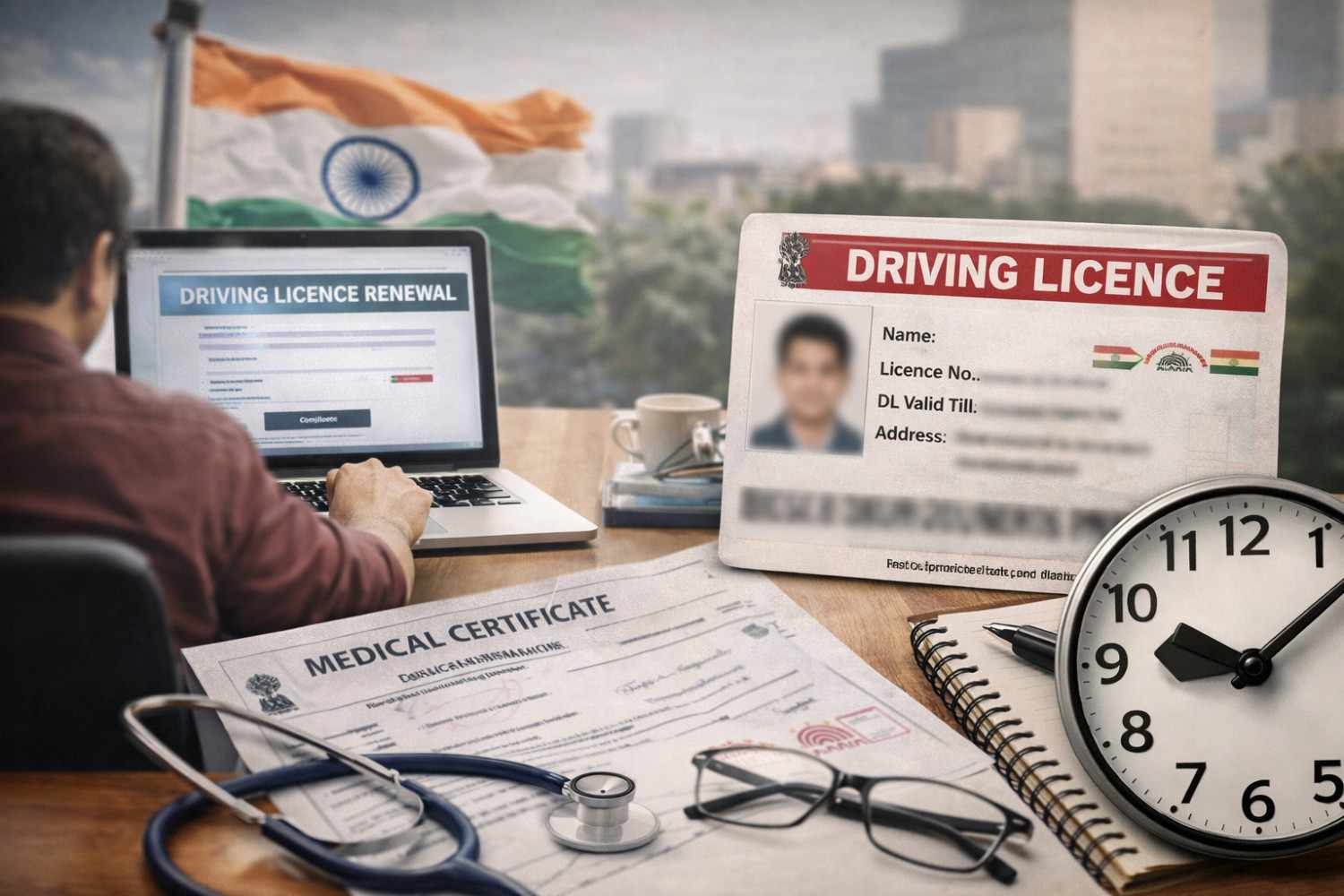
India’s driving licence renewal system has undergone significant procedural changes over the past few years, with the Union government expanding online and faceless services to reduce physical visits to Regional Transport Offices (RTOs) and standardise processes across states. Under the framework set by the Ministry of Road Transport and Highways, citizens can now renew their driving licences largely through a central digital platform, subject to eligibility conditions related to age, licence status and medical fitness. These changes affect millions of motorists and have implications for compliance, road safety and administrative efficiency.
Background: Why driving licence renewal rules matter
A driving licence in India is not a lifetime document. It is issued for a limited period and must be renewed to remain legally valid. Driving with an expired licence can attract penalties under the Motor Vehicles Act and may also invalidate insurance claims in the event of an accident. Renewal norms are therefore a critical part of traffic regulation and road safety enforcement.
Traditionally, licence renewal required in-person visits to RTOs, submission of paper forms, manual verification of records and, in some cases, repeat driving tests. The process varied widely across states and districts, leading to delays and complaints about inefficiency. To address these issues, the central government has gradually digitised transport services through the Parivahan platform, which integrates databases of licences, vehicles and permits.
In parallel, the government introduced the concept of “faceless services” to minimise direct interaction between citizens and officials. This approach aims to reduce discretion, improve transparency and make services accessible regardless of the applicant’s location within a state.
Legal framework governing licence renewal
Driving licence issuance and renewal are governed by the Motor Vehicles Act, 1988, and the Central Motor Vehicles Rules, 1989, as amended from time to time. These laws empower the central government to prescribe uniform standards, while state transport authorities are responsible for implementation through RTOs.
Under the rules, a driving licence is issued with a specific validity period. For non-transport vehicles such as private cars and two-wheelers, licences are generally issued for a longer duration, while transport vehicle licences have shorter validity and stricter fitness requirements. Renewal procedures, fees, grace periods and medical requirements are defined within this regulatory framework.
Any changes to renewal norms or processes are notified by the Ministry of Road Transport and Highways and implemented nationwide, although states may differ in administrative readiness and timelines.
Validity periods and age-linked conditions
One of the most important aspects of licence renewal is validity. For non-transport vehicle licences, the standard validity extends up to a specified age threshold. Once a licence holder crosses that threshold, renewals are granted for shorter periods, typically requiring more frequent reassessment of fitness to drive.
For transport vehicle drivers, validity periods are shorter from the outset, reflecting the higher responsibility associated with commercial driving. Renewal in such cases often requires additional documentation, including medical fitness certificates from authorised practitioners.
The rules also provide a grace period after licence expiry during which renewal can be sought without undergoing certain additional procedures. If this grace period is exceeded, the applicant may be required to complete further formalities, which can include re-verification or testing, depending on the circumstances and the authority’s assessment.
Medical fitness requirements
Medical fitness is a key component of the revised renewal norms. Applicants above a specified age, as well as all transport vehicle drivers, are required to submit a medical certificate in a prescribed format. This certificate must be issued by a registered medical practitioner and confirms that the applicant meets the minimum physical and mental standards necessary to drive.
The introduction of online services has not removed this requirement but has changed how the certificate is submitted. In many cases, applicants can upload a digitally signed or scanned copy of the certificate as part of the online application, subject to later verification.
The emphasis on medical fitness reflects policy concerns around road safety, particularly in relation to vision, reflexes and conditions that may impair driving ability.
The shift to online renewal services
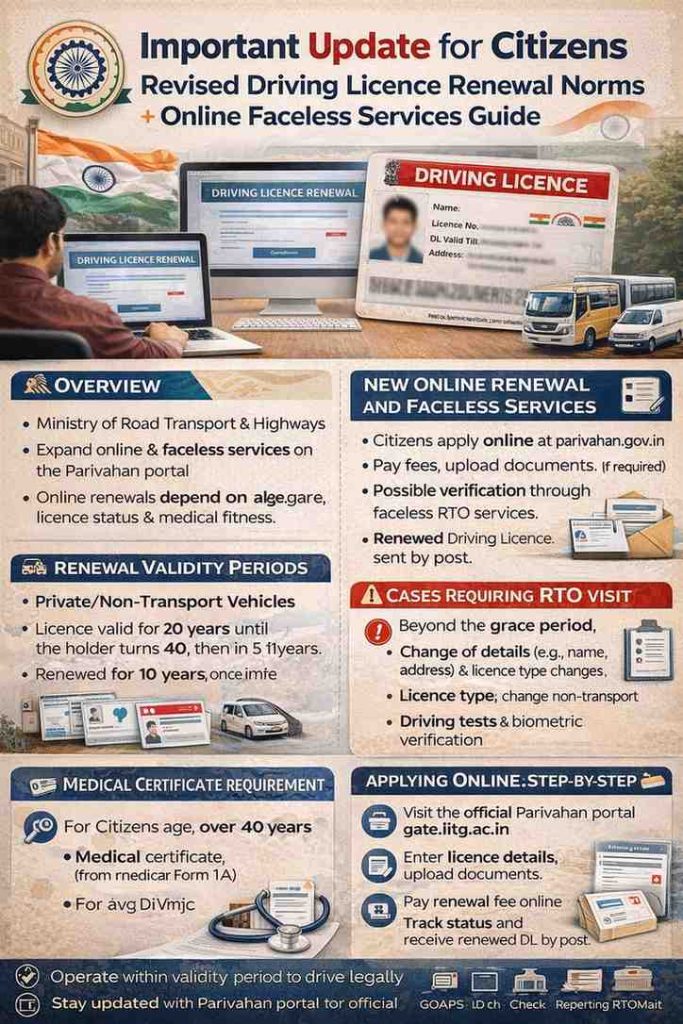
The most visible change for citizens is the expansion of online renewal services through the national transport portal. Eligible applicants can now apply for renewal, upload documents, pay fees and book appointments online.
For many categories of applicants, especially those renewing non-transport licences within the grace period and without changes to personal details, the process can be completed without visiting an RTO. The renewed licence is then dispatched by post to the registered address.
This shift has been gradual, with online services first introduced as optional and later expanded as the default mode for many transactions. The centralised portal allows applicants to track the status of their application and reduces dependence on local office practices.
Introduction of faceless services
Faceless services represent a further step in digitisation. Under this system, applications are processed by officials who do not interact directly with the applicant and may not be located in the same district as the applicant. The idea is to eliminate subjective decision-making and ensure uniform application of rules.
For driving licence renewals, faceless services typically cover document scrutiny and approval stages. Physical presence is still required in certain cases, such as when biometric verification, photograph capture or driving tests are mandated. However, for routine renewals, especially those without changes or complications, the faceless model reduces the need for physical visits.
The rollout of faceless services has been phased, with states opting in based on infrastructure readiness. Over time, more services have been brought under this model, aligning with the government’s broader digital governance agenda.
Step-by-step overview of the renewal process
Under the revised system, a typical online renewal process begins with the applicant accessing the national transport portal and selecting the driving licence renewal service. The applicant enters licence details, verifies personal information and uploads required documents, including proof of address if applicable and a medical certificate where required.
The system calculates the applicable fee based on licence type and validity period. Payment is made online through authorised gateways. Depending on eligibility, the applicant may be prompted to book an appointment for biometric verification or may be allowed to proceed without a visit.
Once the application is submitted, it is processed under the faceless or semi-faceless workflow. After approval, the renewed licence is generated and dispatched. Applicants can monitor progress through the portal.
Cases where physical visits are still required
Despite the expansion of online and faceless services, not all applicants can avoid visiting an RTO. Physical presence is typically required in cases involving expired licences beyond the grace period, changes in personal details such as name or address, conversion of licence type, or discrepancies in records.
Applicants who are required to undergo a driving test or retest must also appear in person. Similarly, biometric capture may be mandated if existing records are incomplete or outdated.
These exceptions highlight that while digital services have streamlined the process, the system still relies on physical verification in certain scenarios to maintain accuracy and integrity.
Impact on citizens
For most private vehicle owners, the revised norms and online services have reduced the time and effort required to renew a driving licence. The ability to complete the process from home, track applications digitally and receive the licence by post represents a significant change from earlier practices.
The faceless model has also addressed long-standing concerns about inconsistency and lack of transparency. By standardising document scrutiny and reducing discretionary interaction, the system aims to treat applicants more uniformly.
However, the transition has also presented challenges. Digital literacy, access to reliable internet and familiarity with online forms remain uneven across regions and age groups. Older citizens, in particular, may find the process difficult without assistance.
Impact on transport authorities
For transport departments, the revised system has shifted the focus from manual processing to digital verification and oversight. Centralised databases allow for better record management and reduce duplication. The faceless workflow also enables workload distribution across offices, potentially improving efficiency.
At the same time, authorities must ensure data accuracy, cybersecurity and system reliability. Technical glitches or inconsistencies between state and central databases can cause delays and require manual intervention.
Training of staff to handle digital systems and assist citizens remains an ongoing requirement as the scope of online services expands.
Road safety considerations
From a policy perspective, the emphasis on timely renewal and medical fitness aligns with broader road safety goals. Ensuring that drivers remain physically and mentally fit, and that licences are periodically reviewed, is seen as a preventive measure against accidents.
The integration of renewal data with enforcement systems also makes it easier to identify expired licences during checks, reinforcing compliance. Digital records improve traceability and can support policy analysis related to driver demographics and renewal patterns.
Common compliance issues and how they are addressed
Despite the streamlined process, certain compliance issues persist. These include failure to renew within the prescribed period, submission of incomplete documents and mismatches between licence records and identity proofs.
The online system incorporates validation checks to flag errors early, prompting applicants to correct them before submission. In cases where discrepancies are detected later, applications may be put on hold pending clarification.
Authorities have also emphasised the importance of keeping contact details updated to receive notifications related to renewal status.
Coordination between states and the centre
Driving licences issued in one state are valid across India, and the renewal system must therefore operate on an interoperable basis. The centralised portal plays a crucial role in enabling cross-state recognition and renewal.
Applicants who have moved to a different state can apply for renewal without transferring records manually, provided their licence details are available in the national database. This interoperability reflects a significant administrative improvement compared to earlier systems.
Looking ahead: consolidation rather than overhaul
Current indications suggest that the government’s focus is on consolidating and refining the existing digital and faceless framework rather than introducing entirely new renewal norms. Improvements are expected in system stability, user interface and integration with other digital identity and address verification mechanisms.
For citizens, the key requirement remains awareness of validity periods, eligibility conditions and documentation requirements. Staying informed and renewing licences on time is essential to avoid penalties and legal complications.
Conclusion
The revised driving licence renewal norms and the expansion of online faceless services represent a structural shift in how transport services are delivered in India. Anchored in existing law and implemented through a national digital platform, the system seeks to balance convenience with regulatory oversight and road safety objectives.
While not all applicants can avoid physical visits, a large proportion of renewals can now be completed online, reducing administrative burden for both citizens and authorities. As the system matures, its effectiveness will depend on consistent implementation, public awareness and continued investment in digital infrastructure.
For licence holders, the message is clear: understand the applicable renewal rules, monitor licence validity and use the official online channels to ensure uninterrupted compliance with the law.
Add outlooknews.in as preferred source on google – click here
Last Updated on: Thursday, January 29, 2026 11:11 am by Outlook News Team | Published by: Outlook News Team on Thursday, January 29, 2026 11:11 am | News Categories: India
About The Author